

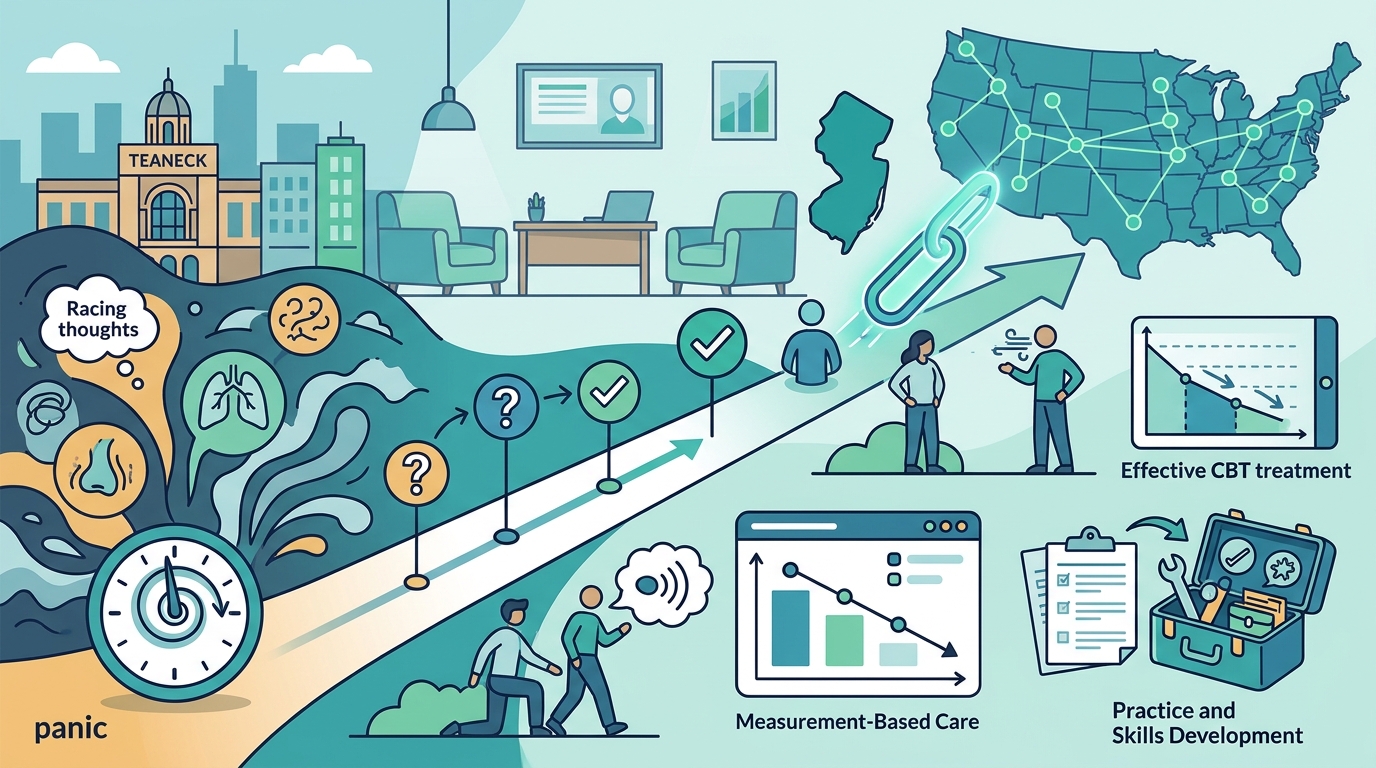
NJ Cognitive Behavioral Therapy Counseling provides specialized, evidence-based CBT treatment for panic attacks and panic disorder in Teaneck, New Jersey, and via telehealth across 42 states. This guide explains how CBT works for panic, details exposure therapy techniques, and outlines how to find the right provider. It covers the clinical approach, the role of measurement-based care, and practical steps for starting treatment.
Understanding Panic Disorder and CBT
Panic disorder is a mental health condition characterized by recurrent, unexpected panic attacks and persistent worry about future attacks. According to the National Institute of Mental Health, symptoms often begin before age 25, though they can emerge in the mid-30s. These episodes involve intense fear accompanied by physical symptoms like a racing heart, sweating, and trembling. Without treatment, individuals may develop agoraphobia, avoiding places where they fear an attack might occur.
Cognitive Behavioral Therapy (CBT) is the gold standard for treating panic disorder. It is a structured, time-limited form of psychotherapy that helps individuals identify and change unhelpful thinking patterns. At NJ Cognitive Behavioral Therapy Counseling, the practice utilizes TEAM-CBT, a specific model that focuses on measurable goals and active collaboration. This approach moves beyond passive listening to provide concrete tools for managing symptoms. Clients learn to challenge catastrophic thoughts and reduce avoidance behaviors that maintain the cycle of panic.
Exposure Therapy Techniques for Panic
Exposure therapy is a core component of CBT for panic disorder. It involves gradually facing feared situations or sensations in a controlled manner. The goal is to habituate to the anxiety response and disprove the belief that panic is dangerous. This technique is distinct from simply enduring discomfort; it requires systematic planning and repetition.
In Vivo Exposure
In vivo exposure involves facing real-world situations that trigger panic. For example, a client might start by walking to a nearby store and then progress to standing in line at a busy supermarket. The therapist helps the client create a hierarchy of feared situations, starting with the least anxiety-provoking and moving to the most challenging. This gradual approach ensures the client feels safe while building confidence. according to Panic Disorder Test
Interoceptive Exposure
Interoceptive exposure focuses on the physical sensations of panic. Clients learn to safely induce symptoms like dizziness or shortness of breath through specific exercises. For instance, spinning in a chair can induce dizziness, while hyperventilating can cause lightheadedness. By experiencing these sensations without catastrophic outcomes, clients learn that the body's alarm system is not a sign of impending doom. This technique is particularly effective for clients who fear that panic will lead to a heart attack or loss of control.
Virtual Reality Exposure
Some practices utilize virtual reality (VR) to simulate triggering environments. This can be useful for clients who find real-world exposure too overwhelming initially. VR allows for precise control over the intensity of the scenario. While not universally available, it is an emerging tool in specialized CBT practices. NJ Cognitive Behavioral Therapy Counseling focuses on traditional in vivo and interoceptive methods, which have a robust evidence base for panic disorder.
Measurement-Based Care and Progress Tracking
Using MBC allows for objective evaluation of whether a treatment plan is working. If a client is not showing progress, the therapist can modify the approach rather than continuing with a strategy that is not effective. This transparency builds trust and empowers clients to take an active role in their recovery. The practice emphasizes that therapy is not just about talking; it is about achieving measurable results.
Telehealth Options for New Jersey Residents
For New Jersey residents, telehealth provides flexibility in scheduling and reduces the barrier of commuting to Teaneck. Clients can attend sessions from the comfort of their homes, which may be helpful for those with agoraphobia. The practice ensures that telehealth clients receive the same level of care and attention as in-person clients. This includes the same measurement-based care protocols and individualized treatment plans.
Finding the Right Provider in New Jersey
Choosing the right provider is critical for successful treatment. Look for a licensed clinical psychologist or therapist with specific experience in CBT for panic disorder. General talk therapy may not provide the structured, skills-based approach needed for panic. At NJ Cognitive Behavioral Therapy Counseling, the lead clinician is an experienced licensed clinical psychologist specializing in CBT, TEAM-CBT, and Exposure and Response Prevention (ERP). This specialization ensures that clients receive targeted, evidence-based interventions.
Consider the following factors when selecting a provider:
- Specialization: Does the provider focus on anxiety and panic disorders?
- Approach: Do they use structured CBT and exposure therapy?
- Measurement: Do they use measurement-based care to track progress?
NJ Cognitive Behavioral Therapy Counseling is located at 764 Palisade Avenue, Suite 1A, in Teaneck, NJ. The practice serves Bergen County and eligible telehealth clients throughout the United States. A complimentary 15-minute initial consultation is available to discuss concerns and determine fit.
Key Takeaways
- Cognitive Behavioral Therapy (CBT) is the evidence-based gold standard for treating panic disorder.
- Exposure therapy, including in vivo and interoceptive techniques, is essential for reducing panic symptoms.
- Measurement-based care ensures that treatment is tailored and progress is objectively tracked.
- Telehealth CBT is an effective and accessible option for residents across 42 states.
- Choosing a provider with specific expertise in panic disorder and CBT is crucial for success.
- A complimentary consultation can help determine if a practice is the right fit for your needs.
Frequently Asked Questions
What is the difference between a panic attack and panic disorder?
A panic attack is a sudden episode of intense fear with physical symptoms. Panic disorder is diagnosed when a person has recurrent panic attacks and persistent worry about future attacks, often leading to behavioral changes like avoidance.
How long does CBT for panic disorder take?
CBT for panic disorder is typically time-limited, often lasting 12 to 20 sessions. The exact duration depends on the individual's progress and the complexity of their case. Measurement-based care helps determine when goals have been met.
Is telehealth CBT as effective as in-person therapy?
What is TEAM-CBT?
TEAM-CBT is a specific model of CBT that emphasizes measurable goals, active collaboration, and a focus on results. It is designed to be efficient and effective, helping clients achieve lasting change in a shorter timeframe.
Does NJ Cognitive Behavioral Therapy Counseling accept insurance?
The practice is considered an out-of-network provider. They provide a superbill for possible reimbursement, and clients are responsible for fees at the time of the appointment. Clients should check their insurance benefits for out-of-network coverage.
Can CBT help with agoraphobia associated with panic disorder?
Yes, CBT is highly effective for agoraphobia. Exposure therapy helps clients gradually face avoided situations, reducing fear and increasing confidence. This is a core component of treatment at specialized practices.
What should I expect in the first session?
The first session typically involves an assessment of your history, symptoms, and goals. The therapist will explain the CBT approach and discuss how it applies to your case. A complimentary 15-minute consultation is available to discuss fit before committing to full treatment.
Conclusion
Specialized CBT treatment for panic attacks and panic disorder is available in New Jersey through both in-person and telehealth options. NJ Cognitive Behavioral Therapy Counseling offers evidence-based, measurement-driven care in Teaneck and across 42 states. By understanding the role of exposure therapy and the importance of choosing a specialized provider, you can take the first step toward recovery. To explore treatment options, schedule a free consultation with NJ Cognitive Behavioral Therapy Counseling today. Learn more: Life Transitions NJ Cognitive.